
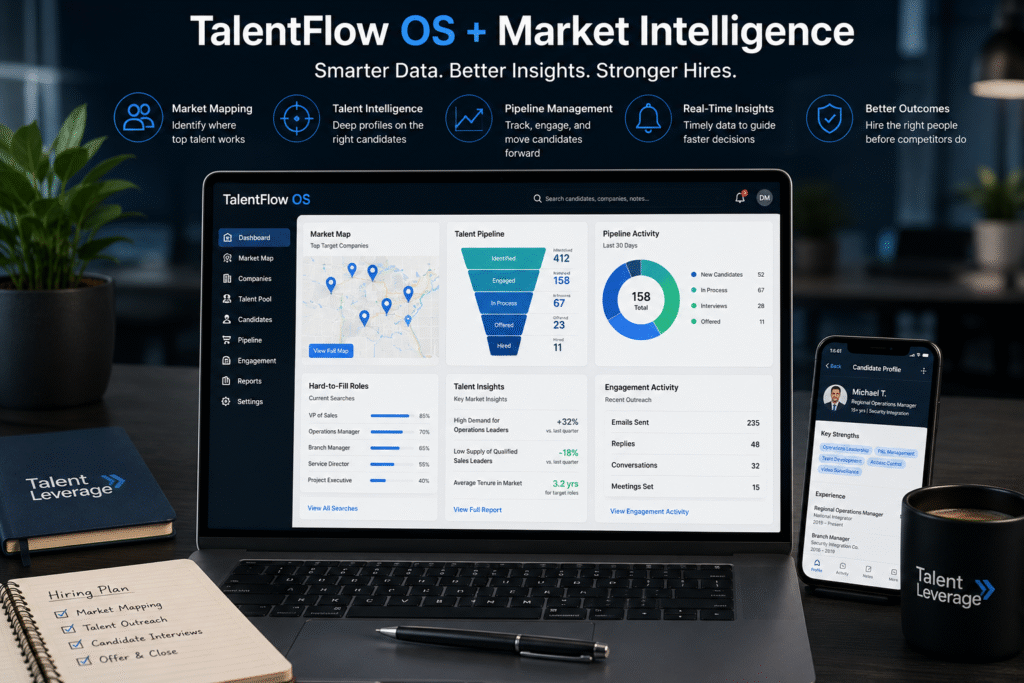
The difference between companies that consistently hire top security integration talent and those that struggle is rarely budget. More often, it is about strategy, speed, and market visibility. In the Security Integration industry, a focused security integration recruiter helps you compete where it matters most. I’m David Masciangelo, Founder of Talent Leverage, and I see this gap every week.
The strongest sales leaders, operations managers, project executives, branch managers, service leaders, business development professionals, and executive leaders are almost never active job seekers. They are running profit centers, winning projects, and fielding calls from competitors and private equity firms. Organizations that rely only on job postings and inbound applicants often settle for whoever is available, not the person who can grow the branch.
This article breaks down how to attract those hidden performers, why job boards fail in security integration hiring, and how to use market intelligence, process design, and relationships to win offers. I will also explain how Talent Leverage and our TalentFlow OS support faster, more accurate security integration recruiting without losing the human side of the hire.
If building a stronger sales, operations, or leadership bench is a priority this year, keep reading.
Key Takeaways
“In security integration, the best people are working, not looking.”
— David Masciangelo, Talent Leverage
Top security integration talent rarely sits on job boards. Most of the best people are employed, hitting quota, and quietly weighing options. Reaching them takes targeted outreach, not posting and hoping.
Slow, unclear hiring processes quietly push strong candidates away. When interviews drag, high performers read that as indecision. Faster, structured hiring wins offers more often.
Market mapping and talent intelligence change hiring outcomes. When you know which companies have the talent you want, you stop guessing. Your recruiting moves become deliberate instead of reactive.
A relationship-first approach beats pure automation in this industry. Security integration leaders respond to people who understand their world. Tools help, but trusted conversations close the gap.
Talent Leverage’s TalentFlow OS combines tech with judgment. It supports sourcing, mapping, outreach, and workflow. I use it so clients hire better people, faster.
Table of Contents
- Key Takeaways
- Why Job Boards And Inbound Applicants Fall Short In Security Integration Hiring
- The Roles That Are Hardest To Fill — And Why They Require A Different Approach
- Practical Strategies To Attract Top Security Integration Talent Before Your Competitors Do
- How TalentFlow OS And Market Intelligence Sharpen Security Integration Recruiting
- Building A Long-Term Talent Strategy That Keeps Security Integration Companies Competitive
- Let Me Help You Build The Team That Drives Your Next Phase Of Growth
- Frequently Asked Questions
- Question 1: Why Can’t I Find Qualified Security Integration Candidates Through Job Postings?
- Question 2: What Roles Does A Security Integration Recruiter Typically Place?
- Question 3: How Quickly Can A Security Integration Recruiter Deliver Candidates?
- Question 4: What Is The Difference Between Contingency And Retained Search For Security Integration Roles?
- Question 5: How Do I Compete For Top Security Integration Talent Against Larger Companies?
- Conclusion
Why Job Boards And Inbound Applicants Fall Short In Security Integration Hiring

Every open role creates a hidden tax on the rest of the organization. Projects get delayed. Service teams absorb extra work. Sales opportunities wait longer for support. Customers feel the strain before leadership does.
The biggest hiring mistake in Security Integration and Loss Prevention is assuming top talent is actively looking. Most aren’t. The best Security Integration candidates don’t wake up looking for jobs. They wake up trying to hit quota, manage projects, and serve customers. Recruiting them requires interrupting success.
Job boards and inbound applicants fall short in security integration hiring because they only expose you to active seekers, not the high performers you actually want. In a market built on relationships and field results, a security integration recruiter has to run targeted outreach into the passive talent pool.
According to LinkedIn, roughly 70 percent of the global workforce is passive, not actively applying to roles. In security integration sales, low voltage operations, and branch leadership, that number feels even higher. The people leading access control, video surveillance, intrusion detection, and integrated systems teams are already tied up in key accounts, upgrades, and service contracts.
Inbound applicants form a self-selected group. Many have some low voltage experience but not the mix of P&L, project delivery, and strategic selling you need in a security integration sales leader or operations manager. I often review stacks of resumes where 90 percent of applicants have residential alarm backgrounds or unrelated IT jobs, while the hiring manager needs enterprise, multi-site, or regulated environment experience.
There is another hidden cost. Time spent screening unqualified applicants is time your branch manager or regional VP is not spending on clients. CyberArk research reveals security risks introduced by everyday employee behaviors, underscoring how much internal bandwidth gets consumed by operational gaps rather than strategic work. According to SHRM, average time to fill professional roles in the US sits well over 40 days. In security integration, every extra week can mean missed bids, delayed installs, and burned-out teams covering open headcount.
Here is the pattern I see again and again:
Companies that depend on job boards wait for talent to come to them.
Companies that treat security integration recruiting as outbound work map the market, call into competitor branches, speak the language of electronic security, and reach the right leaders directly.
Only the second group consistently wins top performers.
The Roles That Are Hardest To Fill — And Why They Require A Different Approach

The hardest roles to fill in security integration are the commercial and leadership seats that tie revenue to delivery. These include security integration sales leaders, branch managers, operations managers, project managers, service leaders, business development professionals, and executive leadership. Each one demands a rare combination of technical fluency and business control.
A strong security integration sales leader understands platforms like LenelS2, Genetec, or Milestone Systems well enough to help on a pre-bid call, yet lives in numbers, margins, and forecast. The same person is getting calls from other integrators, manufacturers such as Honeywell or Johnson Controls, and sometimes even from end users. They are not logging into job boards on their lunch break.
Branch managers and operations leaders sit in a similar spot. They carry responsibility for backlog, field labor, subcontractors, and service response across access control, intrusion detection, and video surveillance. Many are mid-career, rooted in their local market, with kids in school and long-standing relationships with general contractors. They need a clear reason to even take a call, let alone move.
Executive roles raise the bar further. When a security integration executive search involves replacing a VP of Operations or a regional president, the search is usually confidential. You cannot broadcast the opening. A security industry recruiter has to call into competitors quietly, use networks built through ASIS International, SIA, or ESA, and handle conversations in a way that protects everyone involved.
Here is what ties all of these roles together: the people you want are busy, visible, and already successful. They respond to targeted, informed outreach from someone who knows the low voltage and electronic security industry, not to a generic posting written by a generalist recruiter.
To make this more concrete, here is how I see these roles in practice:
| Role | Why It’s Hard To Hire | What Usually Gets Their Attention |
|---|---|---|
| Sales / BD Leader | Big book of business, high OTE, constant calls from competitors | Better territory, stronger support, real growth story |
| Branch / Operations Manager | P&L responsibility, team loyalty, family tied to local market | Clear authority, realistic staffing plan, path to promotion |
| Service Director / PM Leader | Deep client trust, controls recurring revenue and delivery risk | Modern tools, capacity to do good work, voice with execs |
Practical Strategies To Attract Top Security Integration Talent Before Your Competitors Do
Attracting top security integration talent before competitors do requires a proactive plan, not guesses. The core moves are:
Building target company lists
Identifying passive candidates
Compensation positioning
Candidate experience
Interview process design
Hiring speed
Market intelligence
This is where a focused security integration recruiter earns their keep.
Start with a target company list. Identify which integrators, manufacturers, and related firms in your region actually employ the people you want. That may include national players like Allied Universal, Convergint, or ADT Commercial, but also strong regional integrators and low voltage contractors tied into local general contractors. For each company, flag who is likely leading sales, operations, projects, and service.
Next, work the passive side of the market. Instead of waiting for applications, ask current leaders, vendor reps, and even key customers who they respect. Names that show up multiple times often mark top-tier access control or integrated systems talent. A focused security integration recruiter will then approach those people with specifics, not a vague “let us know if you ever look.”
Compensation positioning matters more than many owners realize. Data from Radford and similar compensation surveys shows wide variation by metro area and vertical. If your security integration hiring ranges sit ten or fifteen percent under current market for sales, operations, or leadership roles, you will keep losing late in the process. You do not always need to be highest, but you must be competitive and clear.
Candidate experience might sound soft, yet it is where many companies lose. Research from Glassdoor links long, disorganized hiring processes to lower offer-accept rates. In security integration recruiting, I have seen strong branch manager candidates step away after three weeks with no feedback or no defined next step.
To fix that, treat your process like a project. Define interview stages, decision-makers, and timeframes before you start. For a security integration operations manager or security integration sales leader, a clean three-step process often works:
An initial call focused on facts, fit, and motivation
A structured panel with clear scoring on skills and behaviors
A working session, site visit, or ride-along tied to real work
When everyone knows the plan and decisions move fast, high performers feel that.
“Top candidates judge your company by how you hire, not just what you sell.”
— David Masciangelo, Talent Leverage
Actionable Hiring Strategies At A Glance

Build a named target company list for your region. Include integrators, manufacturers, and low voltage contractors. Update it quarterly as branches open, close, or merge.
Map passive candidates by role and location, not by resume inbox. Track who leads sales, who runs operations, and who owns service. Use that list for direct, informed outreach.
Benchmark compensation for key roles against current US market data. Focus on security integration sales, branch leadership, and operations management. Adjust ranges before you start recruiting.
Design a candidate experience that shows your professionalism from first contact. Give clear timelines, meaningful conversations, and thoughtful feedback. Strong people judge you on this.
Compress your interview process so decisions land within two weeks when possible. High-value candidates in access control, video surveillance, and integrated systems disengage after silence. Speed communicates seriousness.
Set a decision date before opening the search and keep it visible. Share that date with your recruiting partner and internal team. Hold yourself accountable to it.
How TalentFlow OS And Market Intelligence Sharpen Security Integration Recruiting
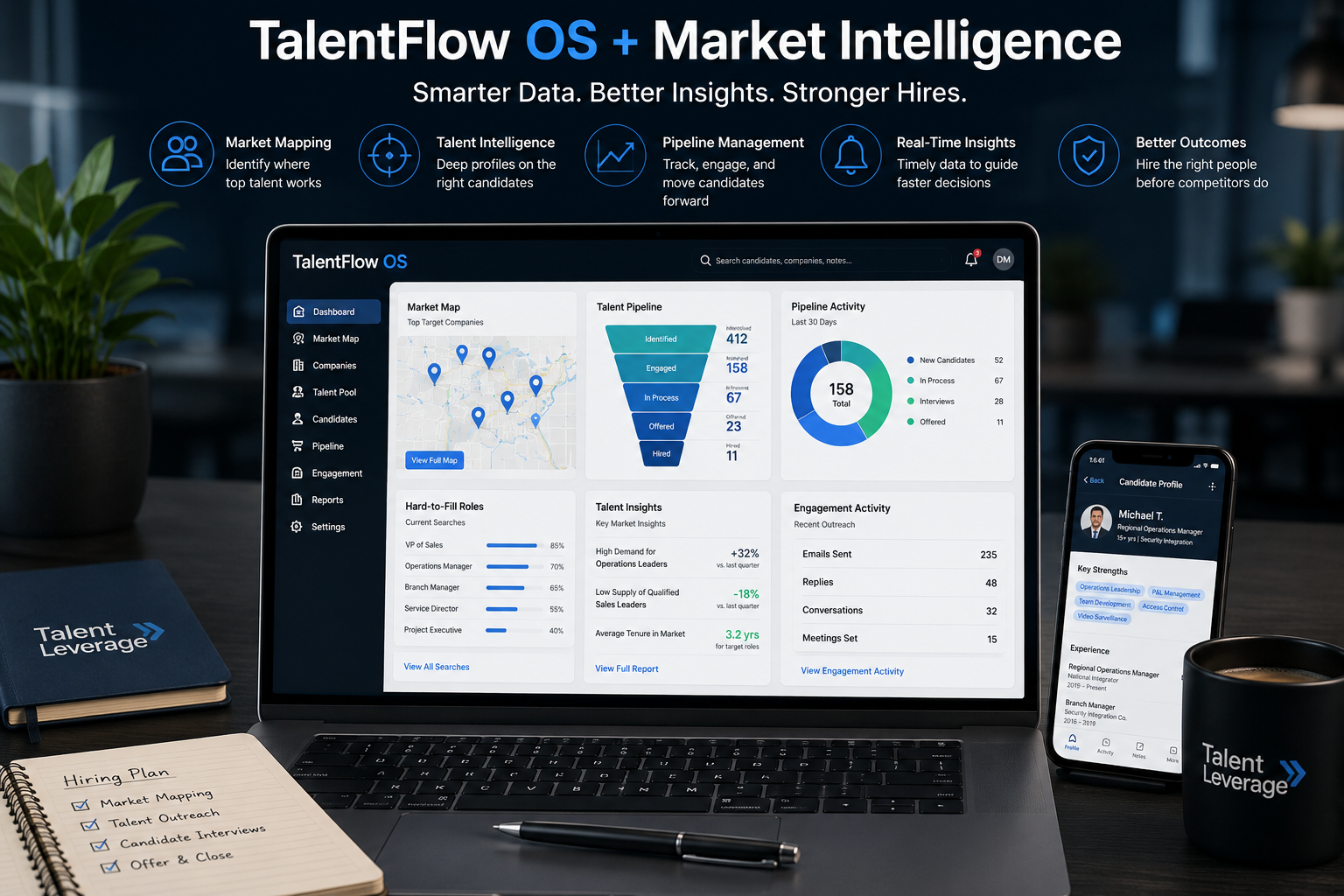
TalentFlow OS and market intelligence sharpen security integration recruiting by combining data, automation, and human judgment. At Talent Leverage, we built TalentFlow OS to give our recruiters better visibility into the security integration talent market while keeping relationships at the center.
On the sourcing and market mapping side side, TalentFlow OS uses AI to search to deep dive across current competitors and databases for companies whose current talent includes people with specific access control, low voltage, or electronic security skillsets aligned with your needs. It flags patterns like repeated promotions, long tenure, or moves between key players such as Genetec, Axis Communications, PSA, Security 101, Convergint, Vector, Acomplis Technology and regional integrators. We track which companies are hiring, which branches grow, and where security integration leadership changes occur. Recent data from the U.S. Bureau of Labor Statistics shows professional job openings still outpace hires, which lines up with what we see in security integration. TalentFlow OS turns that moving picture into a usable map for each client search. That helps the Talent Leverage team prioritize who is most likely a stronger fit before wasting time on one search.
Workflows sit on top of this data. Automated reminders keep candidate outreach and follow-up tight without turning communication into spam. Analytics show intro-to-interview and interview-to-offer ratios by role type. Our 5:1 intro-to-hire ratio comes from watching these numbers closely and tightening our screens.
What TalentFlow OS does not replace is judgment. Only a human recruiter can sit with a security integration executive, hear why they left a prior branch, and sense whether their story fits your culture. Only a human can talk with a skeptical regional sales leader and explain why your private equity-backed platform or growing low voltage business is worth a move. The system supports that work; it does not substitute for it.
Building A Long-Term Talent Strategy That Keeps Security Integration Companies Competitive

A long-term talent strategy keeps security integration companies competitive by making hiring a continuous discipline, not a fire drill. The companies I see winning in access control, video surveillance, and integrated systems treat security integration security integration talent acquisition as a core business function.
They start with visibility. Who are the top five people you would want if your current security integration sales leader, operations manager, or branch manager left tomorrow? If the answer is vague, there is work to do. Talent Leverage often runs talent gap analysis and succession planning sessions with owners and presidents to map these scenarios before a vacancy hits.
According to McKinsey & Company, organizations that align talent strategy closely with business goals are more likely to outperform peers on growth and profitability. In security integration, that looks like linking headcount planning to backlog, recurring revenue, and expansion into new verticals such as healthcare or energy.
Pipeline work matters too. For key markets, we help clients maintain warm relationships with a small set of security integration sales leaders, service directors, and project executives. Some conversations sit idle for months until timing feels right. When a competitor missteps or a private equity recap triggers change, you are ready with a call instead of a rushed job post.
For many clients, we also support workforce forecasting around large projects or acquisitions. Knowing you will need two project managers, one operations leader, and added service leadership six months from now changes how we recruit today. That is how you reduce time-to-fill and stop losing revenue to open chairs.
Let Me Help You Build The Team That Drives Your Next Phase Of Growth
Hiring top security integration and Loss Prevention talent requires more than posting jobs and hoping the right people apply. It requires market intelligence, targeted outreach, and a process designed to engage high performers before your competitors do.
At Talent Leverage, my team and I live in this market every day. We use TalentFlow OS, long-standing industry relationships, and focused outreach to put the right people in front of you, fast. If you want a confidential conversation about your current team, gaps, and plans, I am happy to talk.
You can schedule a private hiring strategy discussion by clicking here.
Frequently Asked Questions
Question 1: Why Can’t I Find Qualified Security Integration Candidates Through Job Postings?
You struggle to find qualified candidates because most high performers are not actively applying. Top people in access control, video surveillance, and low voltage integration already hold good roles and rarely watch job boards. Job postings reach only the active 20 to 30 percent of the market. Passive outreach, market mapping, and trusted recruiter relationships reach the rest.
Question 2: What Roles Does A Security Integration Recruiter Typically Place?
A security integration recruiter typically places sales leaders, business development professionals, branch managers, operations managers, project executives, service leaders, and C-suite roles. The work also covers technical leadership such as RCDD designers and systems engineers in electronic security environments. At Talent Leverage, we support clients across this full spectrum, from field leadership to executive seats.
Question 3: How Quickly Can A Security Integration Recruiter Deliver Candidates?
A focused security integration recruiter can often present strong candidates within a few business days once intake is complete. At Talent Leverage, our standard is to deliver qualified intros in three to five business days and keep roughly a 5 to 1 intro-to-hire ratio. Speed only matters when quality stays high, so every profile is screened carefully.
Question 4: What Is The Difference Between Contingency And Retained Search For Security Integration Roles?
Contingency search pays the recruiter only when a hire is made and fits many mid-level or individual contributor roles. Retained search involves an upfront fee and gives dedicated focus, which suits executive, highly specialized, or confidential security integration searches. Talent Leverage also offers Contained Search, On-Demand support, and Flat-Fee options for clients needing flexible models.
Question 5: How Do I Compete For Top Security Integration Talent Against Larger Companies?
You compete by telling a clear story about growth, impact, and culture, not by trying to match every big-company perk. Experienced security integration professionals often value autonomy, direct access to leadership, and the chance to build something. Talent Leverage helps clients shape and communicate that employer value proposition directly to passive candidates in this market.
Conclusion
The security integration hiring market rewards companies that move with intent and speed. The best sales leaders, operations heads, branch managers, and executives rarely raise their hands; they respond to informed outreach, clear opportunities, and decisive processes.
By moving beyond job boards, mapping your target companies, speaking to passive candidates, and tightening your interview steps, you give yourself a real edge. When you add data-driven tools like TalentFlow OS and a recruiter who lives in this industry, you multiply that effect.
If you are ready to treat security integration recruiting as a strategic advantage, not a guessing game, I would welcome a conversation. Visit talentleverage.com/#contact-us to start planning your next key hire.